About the Freedmen’s Bureau Act
The Act restores what Reconstruction began and protects what our families built. It verifies lineage and delivers services so Freedmen Descendants can live with security, dignity, and opportunity.
FBRMA Access Policy Update
Public access to the full bill is temporarily restricted while Version 5 is being finalized and copyrighted. Institutional partners may request review access by contacting Freedmen Descendants United.
Why this is needed?
The original Freedmen’s Bureau (1865) was created to help formerly enslaved people and their descendants with education, land support, legal protection, and healthcare.
Its mission was cut short by backlash, underfunding, and racial terrorism. The result: generations left unprotected and unrecognized. Official v4 Final edition (October 2025) — The Freedmen’s Bureau Reactivation and Modernization Act of 2025, including all sections and appendices through October 2025.
“They shut the Bureau down — but we’re reopening the doors.”
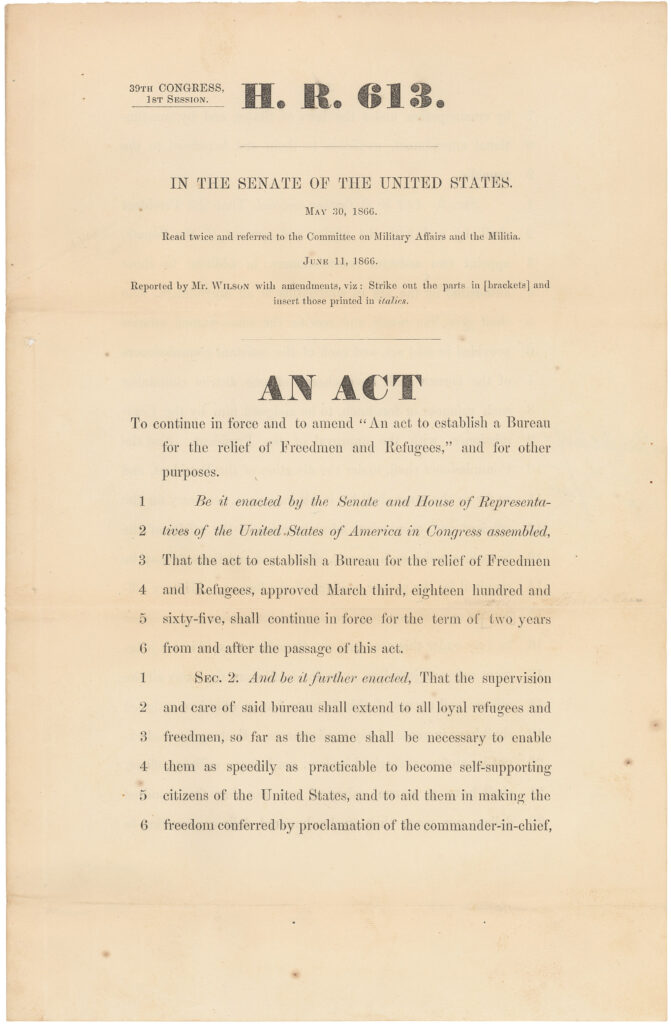
📜 1865: Creation of the Freedmen’s Bureau
Credit
Image courtesy of the U.S. National Archives – Freedmen's Bureau Highlights
1865: Creation of the Freedmen’s Bureau
Established: March 3, 1865, by Congress under the War Department.
Purpose: Provide relief and protection to Freedmen and Refugees during Reconstruction.
What it did:
• Issued rations, clothing, medical care; set up hospitals and temporary housing.
• Supervised labor contracts to replace slave labor with paid work and curb abuse.
• Organized schools with partners (mission societies, HBCU founders, local teachers).
• Helped reunite families and locate loved ones through records and notices.
• Operated Bureau courts where local courts denied justice to Freedmen.
• Managed abandoned/confiscated land and fielded claims (many early grants later reversed).
Why it mattered: The Bureau was the first federal infrastructure aimed at the freedom,
safety, education, and economic start of formerly enslaved people and their families.
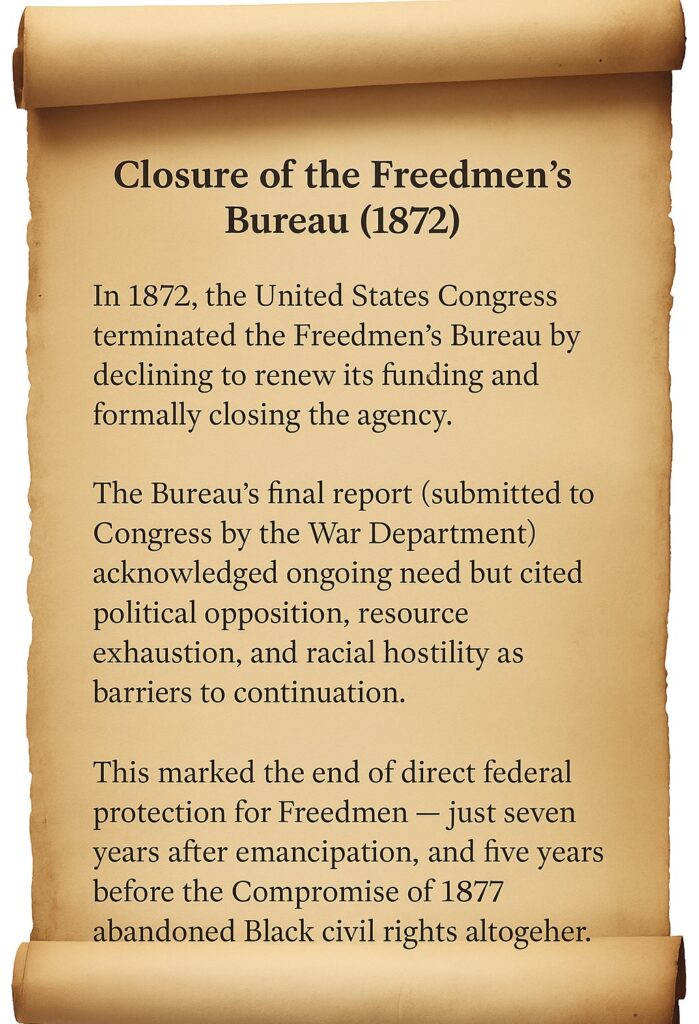
🚫 1872: Closure of the Freedmen's Bureau
Credit
Courtesy of:
U.S. War Department. Annual Report of the Commissioner of the Bureau of Refugees, Freedmen, and Abandoned Lands (1872).
Also referenced in: U.S. House Hearing on The Legacy of the Freedmen’s Bureau (2000),
CHRG-106hhrg75060
What is the Freedmen's Bureau Reactivation And Modernization Act of 2025?
The Freedmen’s Bureau Reactivation and Modernization Act of 2025 reactivates the original 1865 mission as a permanent federal agency—retitled the Bureau of Freedmen Affairs. It delivers repair specifically to Freedmen Descendants (with representation for descendants of Free People of Color) by verifying lineage (FLID), providing services, protecting rights, and building sovereign economic systems with federal oversight.
👥 Who this Act serves
Freedmen Descendants — U.S. chattel-slavery lineage, verified
Families and communities rebuilding wealth, health, and culture
International Human Rights advocacy supports recognition
🧬 Eligibility (lineal descent + evidence)
Lineal descent to persons enslaved in the U.S. before 1877 (incl. U.S. Tribal Nations)
Historical record evidence of classification terms (supporting only)
Exclusion from tribal citizenship on racial grounds, where applicable
Not eligible: no verified U.S. lineage.
🧾 How verification works (FLID)
Enroll → 2) Verify (integrity checks + appeals) → 3) Access services
Outcome: FLID + Emancipation Acknowledgment Letter.
This video offers a voice-over walk-through of the Freedmen’s Bureau Reactivation and Modernization Act of 2025 — told by those who lived the legacy.
🔹 Created by Freedmen Descendants
🔹 Includes Emancipation Acknowledgement Letters
🔹 Establishes Freedmen Credit Unions & Youth Programs
🔹 Proposes federal reparations, land restoration, and cultural revival
Watch to learn how this Act repairs what was broken — and builds what was never given.
How Will This Be Paid For?
The Act funds a national repair over 20 years with a structured 10-Year Policy Action Plan (Appendix K). Annual appropriations phase in and continue until the obligation is satisfied. Any unpaid balance accrues interest so the debt is addressed—not deferred.
🏛️ Funding Sources (public finance)
Redirect waste/overfunded programs and incarceration savings
Close corporate tax loopholes and abusive shelters
Monetize agriculture, innovation, and energy growth streams
Capitalize community financial institutions that serve Freedmen Descendants
Contribute to a Sovereign Reparations Reserve & Endowment
🧩 Freedmen-Owned Solutions (where the dollars build power)
Freedmen Credit Unions (F-CUs) for lending, savings, and capital access
Freedmen Marketplace — a national e-commerce hub (group-revenue model)
Repaired Freedmen Towns & Housing Cooperatives
Education & Trade Hub for skills, small business, and careers
Agri-Tech & Healing Farms; Cultural Restoration Sites & Archives
🏦 Sovereign Reparations Reserve & Endowment (how funds grow)
Federally chartered reserve/endowment with yearly contributions
Prudent investment policy grows principal; earnings help fund programs
Unmet annual obligations carry forward with interest until fully paid
📈 Return on Investment (ROI)
More small businesses, local jobs, and innovation
Better education and health outcomes; lower infant mortality
Green jobs and sustainable development
Long-term reduction in public spending through stability and self-sufficiency
🧰 Stability & Emergencies
The Act includes a Sovereign Reparations Reserve/Endowment for long-term stability. If emergencies occur, the BFA may use separate, supplemental appropriations (disaster/pandemic lines) so Reparations funds remain firewalled. Any unpaid Reparations obligation accrues interest until satisfied.
This is not just repair — it’s reinvention. Freedmen-led solutions will build resilient communities and economic systems for generations.
🇺🇸 What will this mean for America — and does it replace other civil-rights laws or benefits?
Short answer: No.
It strengthens the country without taking anything away.
The Freedmen’s Bureau Act is a targeted remedy for Freedmen Descendants. It operates alongside existing civil-rights laws and social programs—those remain in place. Funding phases in; any unpaid balance accrues interest until the obligation is fully paid. current spending for other groups.
🛡️ What is the CJOC?
Independent Citizens Jury Oversight Corps that reviews public-safety conduct and critical incidents, provides community voice, and improves accountability. Benefits everyone; funded by separate public-safety appropriations.
📡 What is the DRCS?
DRCS is a rights/notice communications app for the public and officers: rights invocation (e.g., right to remain silent), consent logs, secure notices, appeals/redress messaging, safety-footage rules, and transparency dashboards. It interfaces with CJOC and follows strict privacy, security, and due-process standards.
It is not the descendants’ benefits system. The BFA/Freedmen Access Portal handles FLID enrollment, documents, services, and civic voting on Freedmen matters.
💵 Does any of this use Reparations funds?
No. CJOC/DRCS are separately appropriated nationwide reforms. Reparations funds for Freedmen Descendants are segregated and non-supplanting.
“Repairing us doesn’t harm you. It honors the truth.”
“The future doesn’t heal on its own — we have to rebuild it.”
Solutions in the Bill
The Act delivers layered repair—not just a one-time payment. For the complete program set (families, youth, elders, veterans, finance, health, education, land, and culture), see the Solutions & 10-Year Policy Action Plan in the bill.
Not a one-time check
The Freedmen’s Bureau Act establishes the Bureau of Freedmen Affairs (BFA) as a permanent federal agency, parallel to how the Bureau of Indian Affairs (BIA) serves Tribes. Repair is layered and ongoing—recognition (FLID), services, legal protections, community finance and enterprise, education/health access, and cultural restoration—funded over 20 years with a protected reserve/endowment.
When emergent needs arise (e.g., disaster relief or a pandemic), the BFA may request separate supplemental appropriations—without reducing Reparations funds. The long-term goal is growing self-sufficiency over the next 20 years.
🧭 Land & the Freedmen Trust
The Freedmen Trust is a federally chartered steward that holds and develops land for the public benefit of Freedmen Descendants.
Sources: transfer of surplus/under-utilized public lands, voluntary acquisition/donation, and local land banks.
Model: community land-trust/long ground-lease structures to prevent displacement.
Use: housing, agriculture, enterprise space, and cultural restoration.
Safeguards: no seizure of private property; anti-displacement priority.
(Full mechanics live in the bill and will be covered in the video series.)
🧬 Census & Identity Freedmen Descendants American
We honor self-identification, and eligibility is lineage-based.
For program administration, we use the Freedmen Descendant American (FDA) category exactly as written in the bill.
A. AFRICA — write in country/people (optional)
[ ] Africa (country/people): __________________________________________
e.g., Nigerian; Ghanaian (Ewe/Akan); Ethiopian (Amhara/Tigrinya); Somali; Congolese; Wolof; Yoruba; Akan
→ If unknown or not applicable, leave blank. No selection is required.
B. FREEDMEN DESCENDANT AMERICAN (FDA)
[ ] Freedmen Descendant American (FDA)
If checked, you may optionally mark:
[ ] FDA-U (U.S. Domestic) [ ] FDA-T (Tribal Treaty, 1866) [ ] FDA-F (Historic FPOC) [ ] Not sure — I’m still confirming my lineage; do not infer FDA or FAD-NA without my selection.
C. FREEDMEN AMERICAN DESCENDANT — NON-U.S. AMERICAS (FAD-NA)
[ ] FAD-NA (Americas lineage outside the United States)
If checked, you may optionally write in:
Country/people (optional): __________________________________________
e.g., Jamaica; Haiti; Barbados; Trinidad & Tobago; Cuba; Dominican Republic; Puerto Rico; Belize; Guyana; Brazil (Bahia); Colombia (Palenquero)
Clarifications (from the bill):
Selecting FDA does not imply African ancestry or any “Africa” write-in.
Do not infer FDA from “African American,” Caribbean, or African country/people write-ins.
Do not infer African country/people from an FDA selection without a respondent write-in.
- Administrative note: FDA is used for eligibility to U.S.-lineage programs under the Act. “Freedmen American — Non-U.S.” guides referrals/partnerships and recognition; neither changes anyone’s racial self-ID.
💸 Are cash payments addressed?
Yes—within layered repair. The bill provides direct disbursements on a multi-year schedule, tiered by income/need, and covering all living generations up to and including “Beta” (as defined in the bill).
Delivered via Treasury/BFA rails and Freedmen Credit Unions.
Integrated with services, protections, and wealth-building tools—not a one-day payout.
The 20-year funding plan includes a protected Reparations Reserve/Endowment; any unpaid obligation accrues interest.
🗳️ Voting on Freedmen matters
Section 11 establishes the Freedmen Registry, Verification, and Access System that registers verified Freedmen Descendants after enrollment and review. Applications are taken first via Bureau of Freedmen Affairs (BFA) forms (online and hard copy). Once a case is verified, the System issues a Freedmen Lineage ID (FLID) and an Emancipation Acknowledgment Letter, and adds the person to a secure, non-public Freedmen Civic Roll (used to deliver services and civic voting on Freedmen matters). Access to programs happens through the BFA/Freedmen Access Portal.
📝 Application intake & support (before registration)
Forms are available via the BFA website (online), local libraries, and DHS (hard copies). Mail-in is supported. Pilot regional offices run outreach, workshops, and assisted genealogy for preliminary record recovery, plus transition to FLID physical-card creation centers, and Freedmen resource hubs. Section 11 receives completed applications for verification and, if approved, registers the descendant.
🧾 Verification → Registration
Review uses layered evidence (vital, census, church, court, military, property, etc.). Applicants receive a decision & notice with a clear appeal path. If approved: issue FLID + Emancipation Acknowledgment Letter (EAL when applicable) and register on the secure, non-public Freedmen Civic Roll (used for services and civic voting on Freedmen matters).
Only lineages with emancipated enslaved ancestors receive an EAL. Exclusively FPOC lines receive a Pre-Emancipation Free Status notation (PFSN) for the record. Mixed lines (Freedmen + FPOC) do receive an EAL.
🛡️ Full personhood & permanent citizenship
This Act affirms a “Five-Fifths” principle—repudiating the historic three-fifths devaluation—and recognizes full personhood and permanent U.S. citizenship of Freedmen and their Descendants. Registration (FLID/EAL) is a civil recognition of lineage, not a substitute for general identification documents, and does not alter public election rights or anyone else’s benefits. Programs operate consistent with civil-rights, due-process, and nondiscrimination standards.
This clause applies to natural persons only (human beings) and does not create or expand corporate personhood. Corporate entities are legal fictions for limited purposes (e.g., contracts, suits) and are not counted as persons for dignity, citizenship, or Reparations eligibility.
How many fifths is a corporation? Zero. “Five-Fifths” is an affirmation of full human personhood.